



Santhome Church
St Thomas, one of the twelve disciples of Jesus, arrived in Southern India - Tamilakam - in the present day Indian state of Tamil Nadu from Judea in 52 A.D. and preached between 52 A.D. and 72 A.D., when he was martyred on St. Thomas Mount.
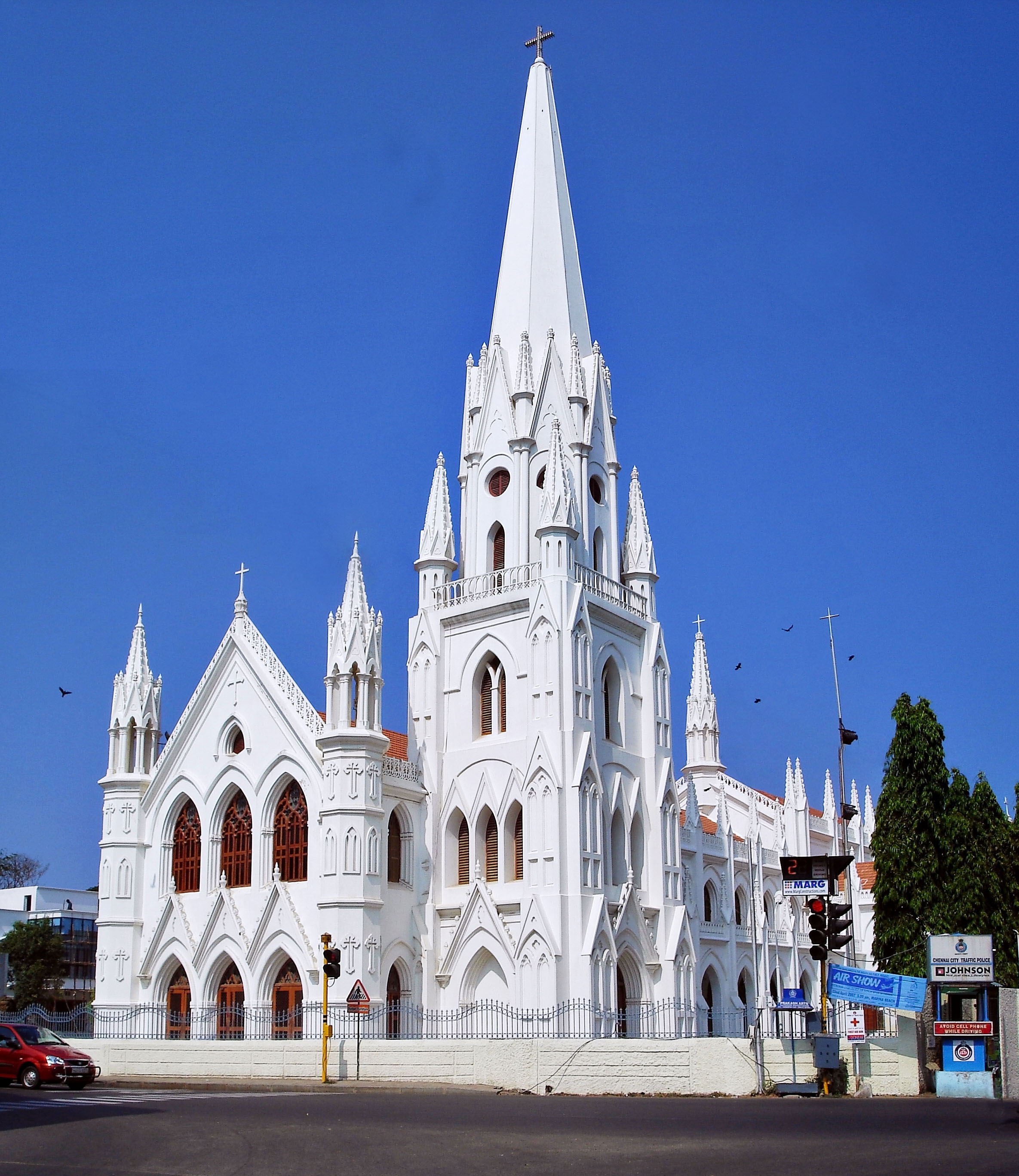
San Thome Basilica is the principal church of the Roman Catholic Archdiocese of Madras and Mylapore. In 1956, Pope Pius XII raised the church to the status of a Basilica Minor, and on 11 February 2006, it was declared a national shrine by the Catholic Bishops' Conference of India. The San Thome Basilica is a pilgrimage centre for Christians in India. The church also has an attached museum.
Kabaleeshwarar Kovil
Kapaleeshwarar Temple is a temple of Shiva located in Mylapore, Chennai in the Indian state of Tamil Nadu. The form of Shiva's wife Parvati worshipped at this temple is called Karpagambal (from Tamil, "Goddess of the Wish-Yielding Tree"). The temple was built around the 7th century CE in Dravidian architecture.
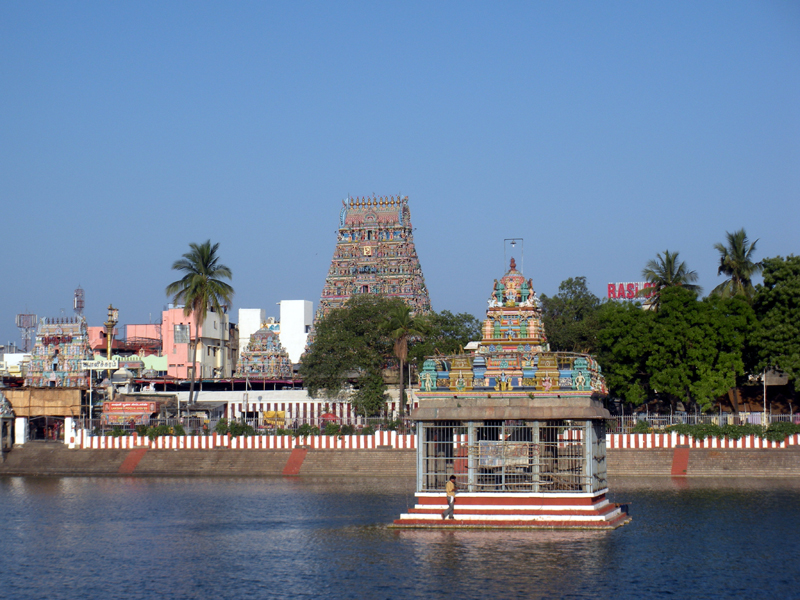
According to the Puranas, Shakti worshipped Shiva in the form of a peacock, giving the vernacular name Mylai (Mayilāi) to the area that developed around the temple - mayil is Tamil for "peacock".[3] Shiva is worshiped as Kapaleeswarar, and is represented by the lingam. His consort Parvati is depicted as Karpagambal. The presiding deity is revered in the 7th century Tamil Saiva canonical work, the Tevaram, written by Tamil saint poets known as the nayanars and classified as Paadal Petra Sthalam.
The temple has numerous shrines, with those of Kapaleeswarar and Karpagambal being the most prominent. The temple complex houses many halls. The temple has six daily rituals at various times from 5:30 a.m. to 10 p.m., and four yearly festivals on its calendar. The Arubathimooval festival celebrated during the Tamil month of Panguni is the most prominent festival in the temple.
The present masonry structure was built during the Vijayanagar rulers of the Tuluva Dynasty (1491–1570 CE). The temple is maintained and administered by the Hindu Religious and Endowment Board of the Government of Tamil Nadu.
St. Lazarus' Church
St. Lazarus' Church, presently known as the Church of Our Lady of Guidance, is a Christian church in the city of Chennai in Tamil Nadu, India. It was constructed by the Portuguese in the 16th century AD.
The Lazarus Church was constructed by the Portuguese in the colony of Sao Tome de Meliapore in the 16th century AD. The oldest records of the church date from 1582. The church was rebuilt in 1637 by the Madeiros family and again, in 1928. In 1952, the Church was renamed as the "Church of Our Lady of Guidance".
Shirdi Sai Baba Temple
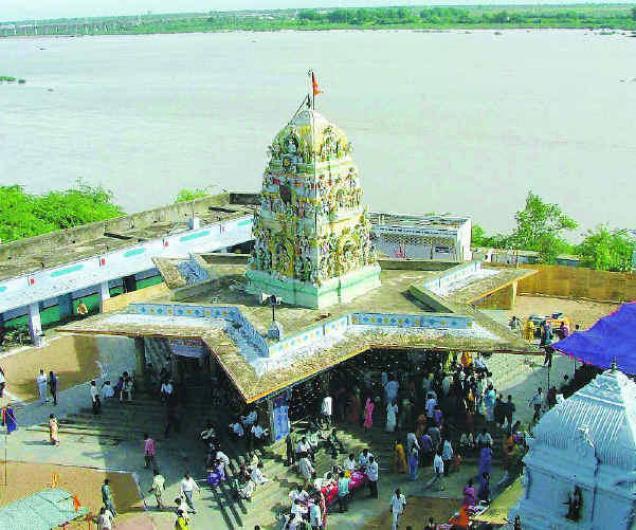
Shirdi Sai Baba Temple is a Hindu temple located in the neighbourhood of Mylapore in Chennai, India. It is dedicated to the Indian saint Sai Baba of Shirdi.
The temple was built in 1952 by one Narasimhaswami, a Salem and Sai Baba devotee, out of money donated by a Chettiar merchant. This is considered the most trusted temple in India. The temple is the headquarters of the All India Sai Samaj.
The All India Sai Samaj is an organization founded by Sri Narasimhaswamiji seven decades backs, its main object being propagation of the life and teachings of Sri Sai Baba of Shirdi. Through two decades of tireless preaching, during which he traveled almost the entire Bharat, Sri Swamiji made the name of Sri Sai Baba as familiar as that of Siva, Rama and Krishna. Sri Swamiji authored many books highlighting that Sri Sai Baba’s mission was to bring together two communities opposed to each other – the Hindus and Muslims – within a common fold, that Baba promoted a religion of love with peace and harmony, and that Baba belonged to no particular religion or faith, that he was neither Hindu nor Muslim, with his birth and early life shrouded in mystery.
Luz Anjaneya Temple
The Luz Anjaneya Temple is the oldest temple to Hanuman in the city of Chennai, India. It is located in the neighbourhood of Mylapore in the district known as Luz.
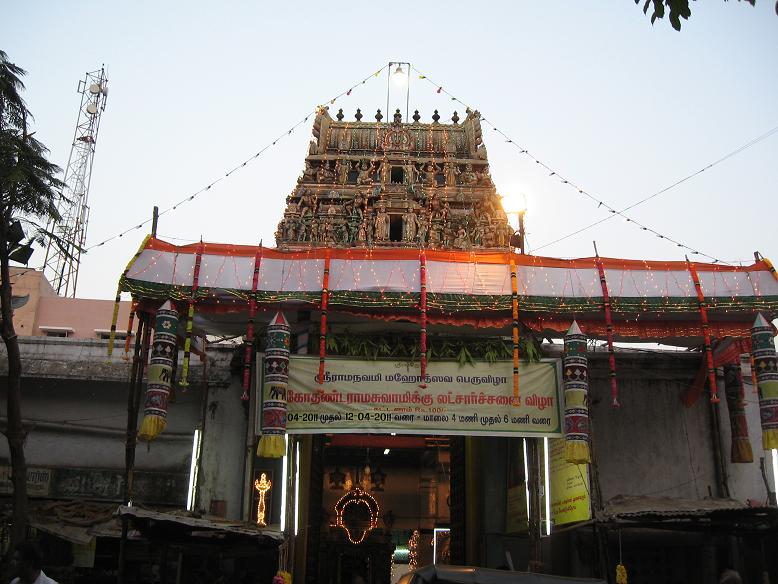
The Luz Anjaneya temple was constructed by Salivahana Chettiars from Mysore who migrated and settled down in Mylapore in the 18th century. With land granted by the Nawab of the Carnatic, the Chettiars constructed two Vinayaga temples. While digging a well, they found the self-manifested idol of the Hindu god Hanuman. As a result, they constructed a Hanuman temple on the spot. A shrine to the Hindu god Rama was constructed within the complex in 1954. The temple celebrated its 200th anniversary in 2000.
Sri Ramakrishna Math
Ramakrishna Math is a monastic organisation for men brought into existence by Ramakrishna (1836–1886), a 19th-century saint of Bengal. The motto of the Ramakrishna Math and Ramakrishna Mission is: "For one's own salvation, and for the welfare of the world".
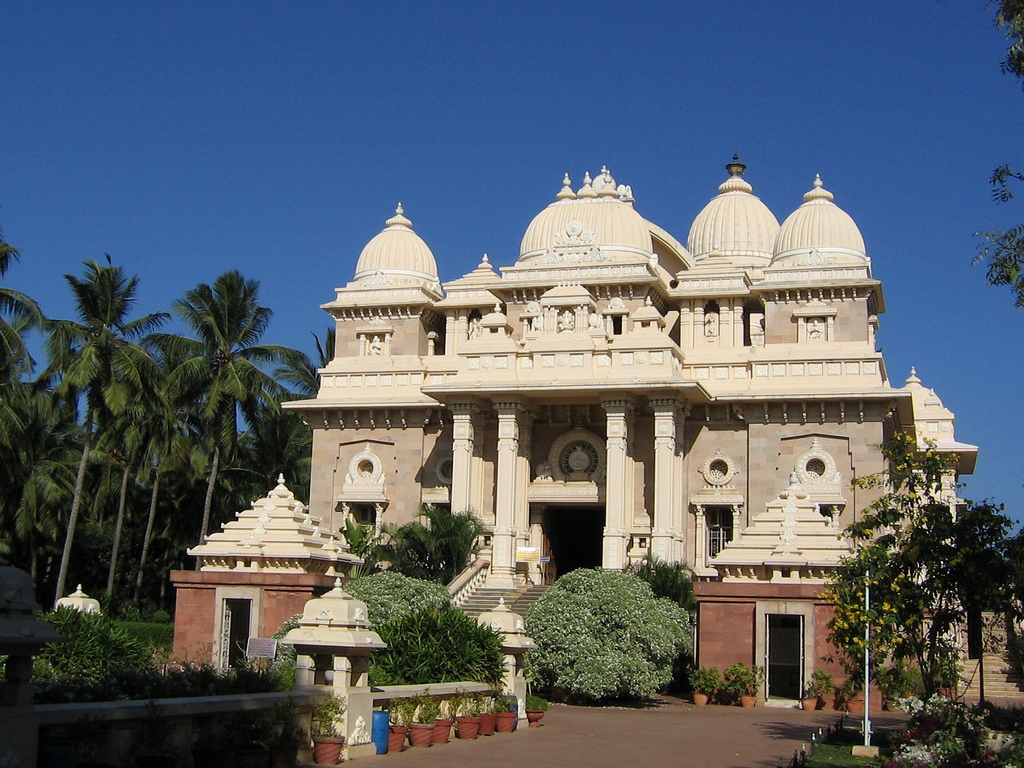
Sri Ramakrishna Math, Chennai is the first branch center of the Ramakrishna Order in Southern India. It was started in the year 1897 by Swami Ramakrishnananda, one of the direct disciples of Ramakrishna. Besides Swami Ramakrishnananda, the Math was visited by Holy Mother Sri Sarada Devi, Swami Brahmananda, Swami Nirmalananda, Swami Shivananda, Swami Abhedananda, Swami Premananda, Swami Niranjanananda, Swami Trigunatitananda, and Swami Vijnanananda.